




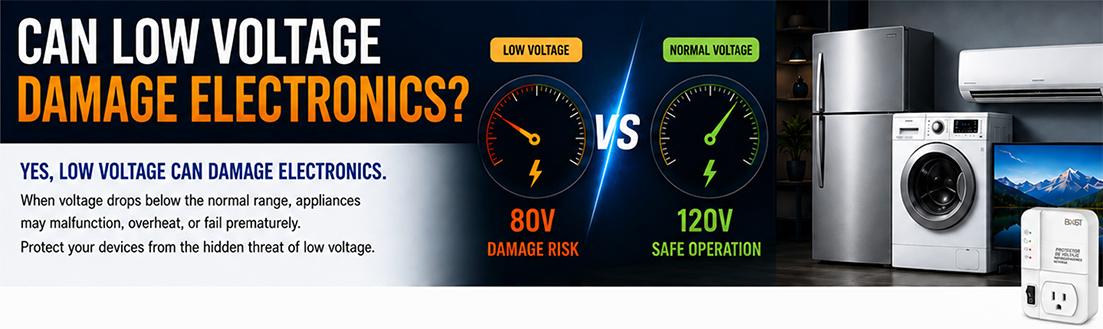
Yes, low voltage can damage some electronic devices and electrical appliances, especially when the condition is prolonged, severe, or occurs repeatedly.
Many people assume that only high voltage or power surges can damage electrical equipment. However, low voltage—also called under-voltage—can also create serious problems.
When the voltage supplied to an appliance falls below its normal operating range, the equipment may not receive enough electrical energy to operate correctly. Motors may overheat, compressors may struggle to start, and electronic power supplies may malfunction or repeatedly restart.
This is particularly important in areas where voltage fluctuations, brownouts, and unstable power supplies are common.
In this article, we'll explain:
- What low voltage means
- How low voltage affects electronics
- Which appliances are most vulnerable
- Whether low voltage can damage refrigerators and air conditioners
- The difference between temporary and prolonged low voltage
- How a voltage protector can help
What Is Low Voltage?
Low voltage, in the context of household power quality, means that the incoming supply voltage has fallen below the normal operating range expected by an appliance or electrical system.
For example, if an appliance is designed to operate at a particular nominal voltage, a significant drop below its acceptable operating range can cause abnormal operation.
Low voltage can happen because of:
- Overloaded electrical grids
- High electricity demand
- Long-distance power transmission
- Poor electrical wiring
- Loose connections
- Utility problems
- Large motors starting nearby
- Power grid disturbances
- Brownouts
A temporary voltage drop may cause an appliance to stop working or restart.
Repeated or prolonged low voltage can create much greater stress.
Can Low Voltage Damage Electronics?
Yes—but the effect depends on the type of electronic equipment.
Modern electronic devices often contain switching power supplies designed to operate across a specific input-voltage range.
If the incoming voltage becomes too low, the power supply may:
- Stop operating
- Restart repeatedly
- Draw increased input current
- Generate excessive heat
- Produce unstable output voltage
- Cause the device to malfunction
Sensitive components can be affected if the equipment operates outside its specified voltage range for extended periods.
The important point is that low voltage does not automatically mean immediate damage. The actual risk depends on the equipment design, voltage level, duration, load, and protection built into the device.
How Does Low Voltage Affect Electrical Appliances?
Different appliances respond differently to low voltage.
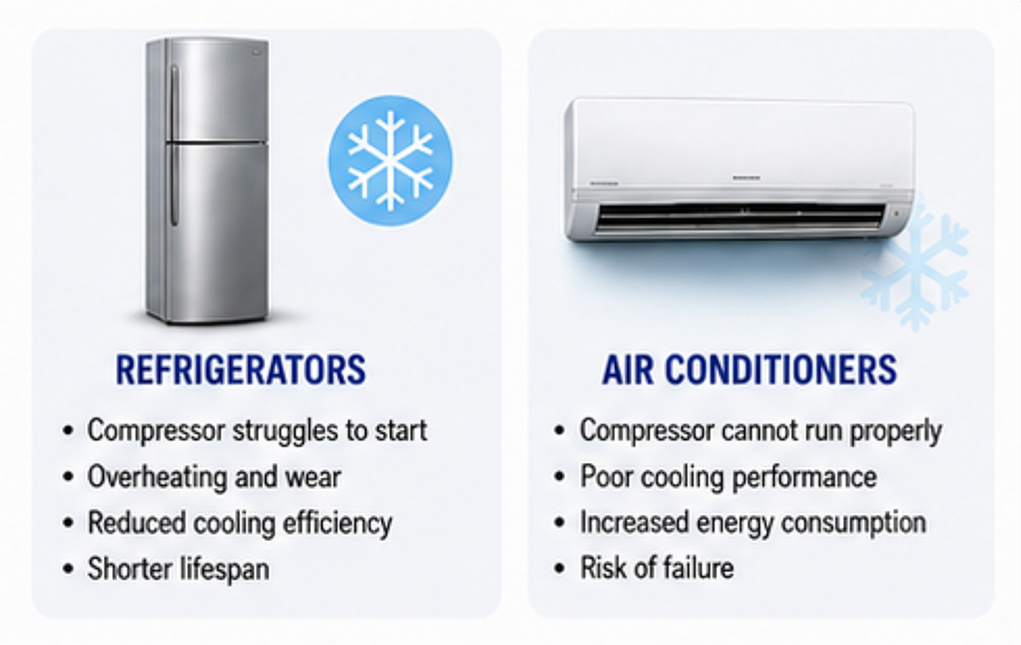
1. Refrigerators
Refrigerators are particularly important because their compressors must start and operate properly.
When voltage is too low, a compressor may have difficulty starting.
This can lead to:
- Repeated starting attempts
- Increased current draw
- Motor overheating
- Compressor stress
- Reduced cooling performance
- Premature component failure
Modern refrigerators may also contain electronic control boards and inverter technology, making them sensitive to unstable power.
This is why a refrigerator voltage protector can be particularly useful in areas with unstable electricity.
2. Air Conditioners
Air conditioners can also be vulnerable to low voltage.
An air conditioner's compressor requires sufficient electrical power to start and operate correctly.
Under-voltage conditions can cause:
- Compressor overheating
- Reduced cooling capacity
- Increased electrical stress
- Repeated restart attempts
- Electronic control board problems
Inverter air conditioners can be even more sensitive because they rely on sophisticated electronic control systems.
For regions with frequent voltage fluctuations, an AC voltage protector can help disconnect the air conditioner when the incoming voltage becomes unsafe.
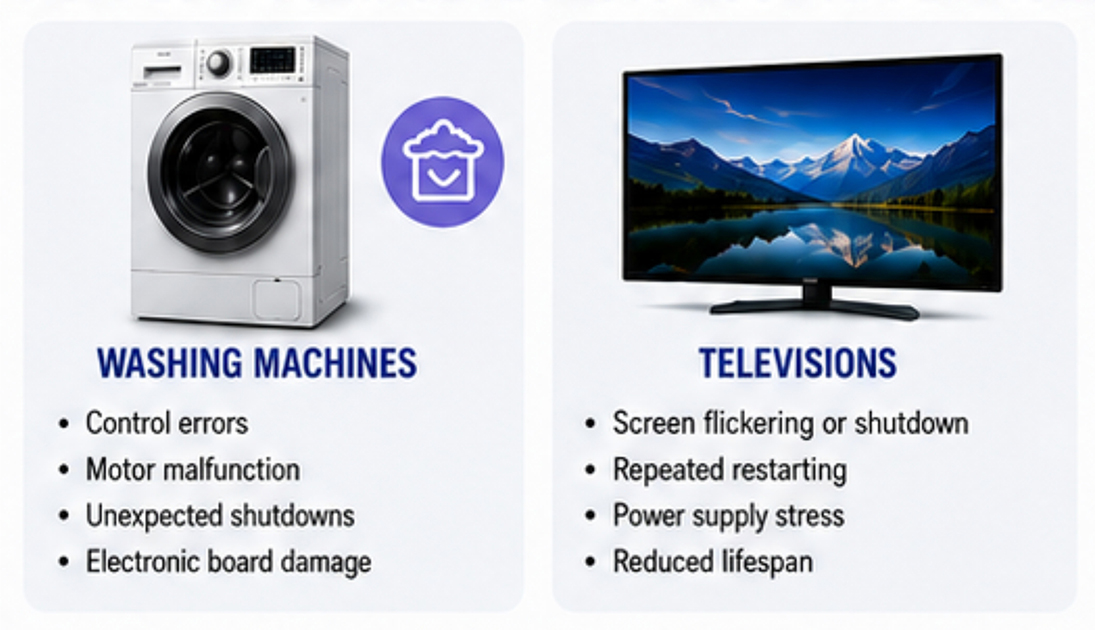
3. Washing Machines
Modern washing machines use electronic control boards, motors, sensors, and switching power supplies.
Low voltage can cause:
- Control errors
- Unexpected shutdowns
- Failed motor operation
- Repeated restarting
- Electronic component stress
If the voltage frequently fluctuates, these problems can become more common.
4. Televisions
Televisions generally use electronic power supplies designed for a specified input range.
A moderate voltage reduction may not immediately damage a modern TV if its power supply can compensate.
However, severe or unstable low voltage can cause:
- Screen shutdown
- Repeated restarting
- Flickering
- Audio or picture problems
- Power supply stress
If low voltage occurs frequently, protecting the TV and other sensitive electronics can be worthwhile.
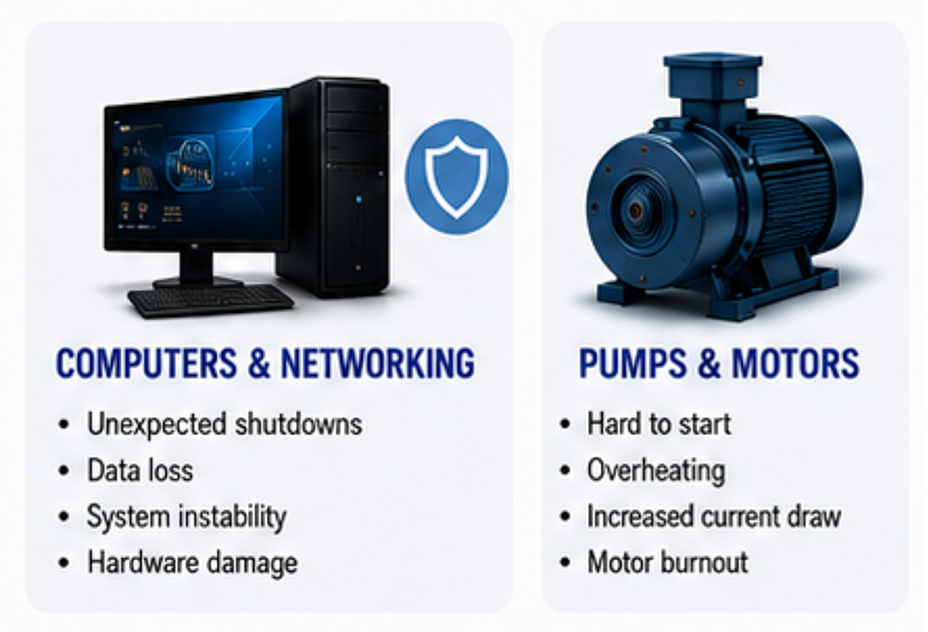
5. Computers and Networking Equipment
Computers, routers, modems, and other electronic devices are also sensitive to unstable power.
Low voltage may cause:
- Unexpected shutdowns
- System restarts
- Data loss
- Network interruptions
- Power supply problems
For computers and critical electronics, a UPS can provide additional backup and power conditioning depending on the application.
Why Can Low Voltage Be Dangerous for Motors?
Motors deserve special attention.
When a motor operates under significantly reduced voltage, it may struggle to produce the torque required by the load.
This can increase operating stress and heat generation.
The risk becomes greater when the motor is:
- Heavily loaded
- Starting repeatedly
- Operating for long periods
- Connected to an unstable power supply
This is one reason why refrigerators, air conditioners, pumps, and other motor-driven appliances can be particularly vulnerable to under-voltage.
Low Voltage vs Brownout: What's the Difference?
The terms are related but not identical.
Low Voltage
Describes an electrical condition where the supplied voltage is below the equipment's normal operating range.
Brownout
Usually refers to a deliberate or unintended reduction in electrical supply voltage across part of the power system.
A brownout may therefore create a low-voltage condition for connected appliances.
A simple way to understand it is:
Brownout → Voltage Drops → Appliances Receive Low Voltage
This is why brownouts can become a hidden threat to household appliances.
Can Low Voltage Damage a Refrigerator Compressor?
Yes.
The compressor is one of the components that can be affected by prolonged or severe under-voltage.
A simplified sequence can look like this:
Low Voltage
↓
Compressor struggles to start
↓
Electrical and thermal stress increases
↓
Repeated starting / overheating
↓
Reduced compressor lifespan
This does not mean every low-voltage event will damage a compressor. Modern appliances include protective mechanisms, and the actual outcome depends on the voltage level, duration, compressor design, and operating conditions.
However, repeated voltage problems can increase the risk of premature failure.
Can Low Voltage Damage an Air Conditioner?
Yes.
Air conditioners can be particularly vulnerable because compressors consume significant electrical power.
Low voltage may cause the compressor to operate outside its intended conditions.
Potential consequences include:
- Compressor overheating
- Poor cooling
- Higher operating stress
- Control system errors
- Reduced equipment lifespan
If an air conditioner is installed in an area with frequent brownouts or voltage fluctuations, under-voltage protection should be considered.
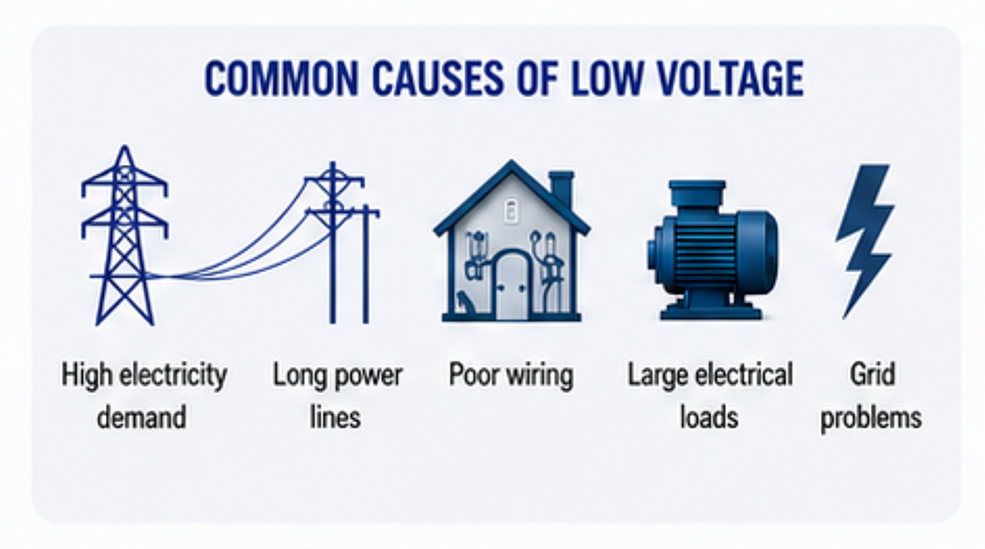
What Causes Low Voltage at Home?
If you frequently notice dimming lights or appliances behaving strangely, several factors could be responsible.
High Electricity Demand
During periods of heavy electricity use, local distribution systems may experience voltage drops.
Long Power Lines
Long distances between the power source and the property can contribute to voltage drop.
Poor Wiring
Undersized cables, loose connections, or aging electrical installations can create additional voltage problems.
Large Electrical Loads
Air conditioners, pumps, compressors, and other high-power equipment can influence voltage when they start.
Grid Problems
Utility-side faults and unstable distribution networks can cause temporary or repeated low-voltage conditions.
Signs That Your Home May Have Low Voltage
You may not always need specialized equipment to notice that something is wrong.
Common warning signs include:
- Lights becoming noticeably dimmer
- Air conditioners struggling to start
- Refrigerators making unusual starting sounds
- Fans running more slowly
- Motors overheating
- Electronics restarting unexpectedly
- Appliances shutting down randomly
- Voltage readings changing significantly
However, visual symptoms alone cannot confirm the exact voltage condition.
If you suspect a serious electrical problem, the supply should be checked using appropriate measuring equipment by a qualified professional.
How Can You Protect Electronics from Low Voltage?
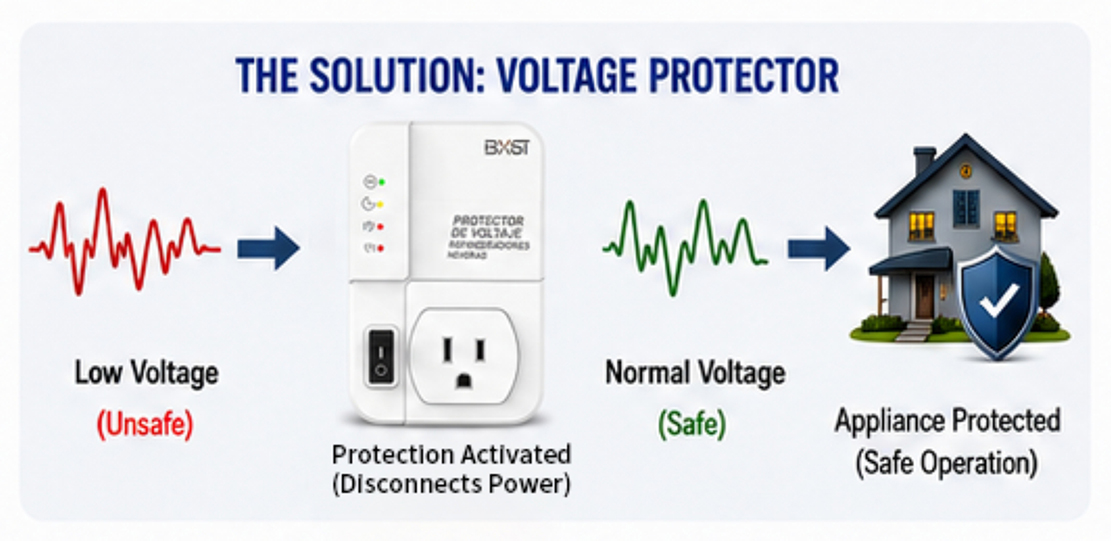
One of the simplest solutions is to use a voltage protector with under-voltage protection.
A voltage protector continuously monitors the incoming voltage.
When the voltage is within the safe operating range:
Normal Voltage → Power Connected → Appliance Operates
When the voltage falls below the preset protection threshold:
Low Voltage → Protection Activated → Appliance Disconnected
Once the voltage returns to a suitable level, the protector can reconnect the appliance after a preset delay.
Why Is Automatic Delay Important?
Automatic delay is particularly useful for refrigerators and air conditioners.
Imagine a blackout followed by unstable power:
Blackout
↓
Power Returns
↓
Voltage Fluctuates
↓
Voltage Protector Detects Unsafe Condition
↓
Appliance Remains Disconnected
↓
Voltage Stabilizes
↓
Delay Period Ends
↓
Appliance Restarts
This helps prevent appliances from immediately restarting during an unstable power condition.
Voltage Protector vs Voltage Stabilizer
These products are often confused.
A voltage protector primarily protects equipment by monitoring voltage and disconnecting the load when voltage becomes unsafe.
A voltage stabilizer is designed to regulate the output voltage toward a desired level.
They serve different purposes.
For example:
| Voltage Protector | Voltage Stabilizer |
|---|---|
| Monitors voltage | Regulates voltage |
| Disconnects during unsafe conditions | Adjusts output voltage |
| Under-voltage protection | Voltage correction |
| Over-voltage protection | Voltage regulation |
| Often includes delay restart | Provides a regulated output |
| Designed primarily for protection | Designed primarily for voltage stabilization |
Does a Surge Protector Protect Against Low Voltage?
Usually, not by itself.
A traditional surge protector is primarily designed to protect against sudden increases in voltage, such as transient surges and spikes.
It does not necessarily provide protection against sustained low voltage.
If your electrical supply experiences both:
- Power surges
- Under-voltage
you should consider a protection solution that specifically addresses both conditions.
Which Appliances Should Have Low-Voltage Protection?
Under-voltage protection can be especially useful for:
- Refrigerators
- Air conditioners
- Freezers
- Water pumps
- Washing machines
- Compressors
- Motors
- Sensitive electronic equipment
- Solar inverters
- Commercial electrical equipment
The protection device should always be selected according to the equipment's rated voltage, current, load, and electrical system.
Why Low Voltage Protection Is Important in Areas with Unstable Power
Not every region has the same power quality.
Some markets frequently experience:
- Brownouts
- Voltage fluctuations
- Power outages
- Sudden power restoration
- Over-voltage
- Under-voltage
For distributors and electrical equipment suppliers operating in these markets, voltage protection can be an important part of appliance safety.
It can also provide an opportunity for manufacturers and brands to offer customers a complete solution rather than simply selling the appliance itself.
Choose Reliable Voltage Protection with BXST
Low voltage may not be as dramatic as a lightning strike or a sudden blackout, but repeated under-voltage conditions can create serious stress for electrical appliances and electronic equipment.
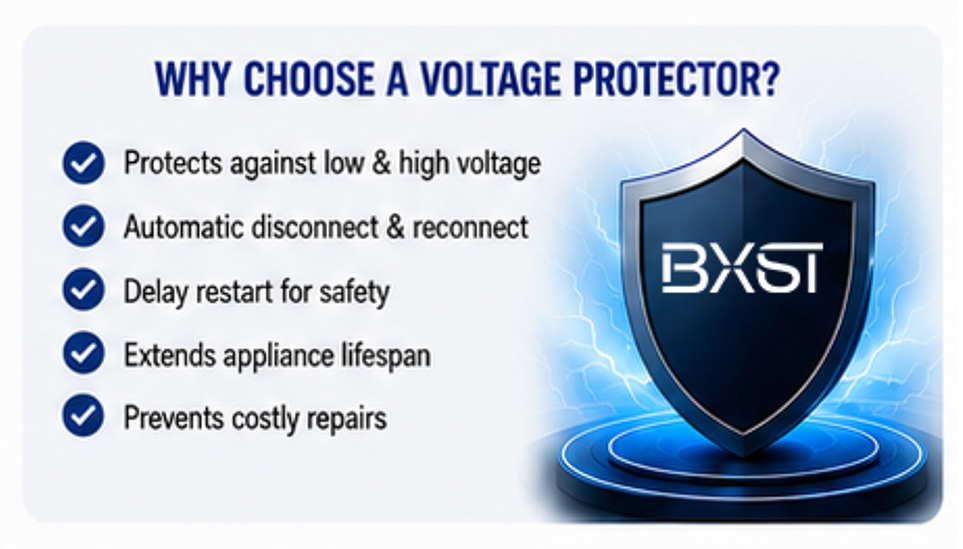
A suitable voltage protector can help identify unsafe voltage conditions and disconnect equipment before it continues operating under potentially harmful conditions.
BXST specializes in the manufacturing of voltage protectors and electrical protection solutions for residential, commercial, and OEM applications.
Our solutions can be used for applications including:
- Refrigerators
- Air conditioners
- Water pumps
- Washing machines
- Home appliances
- Electrical equipment
- OEM and private-label products
For distributors, importers, wholesalers, and electrical brands, BXST can also provide customized product and OEM manufacturing solutions according to different market requirements.
Don't wait for unstable voltage to damage valuable equipment. Protect your appliances with reliable voltage protection.
Frequently Asked Questions
Can low voltage damage electronics?
Yes. Severe, prolonged, or repeated low voltage can cause electronic devices to malfunction and may stress or damage power supplies and other components.
Can low voltage damage a refrigerator?
Yes. Low voltage can make the compressor difficult to start and increase electrical and thermal stress, especially when the condition is repeated or prolonged.
Can low voltage damage an air conditioner?
Yes. Under-voltage can cause compressor and electronic control problems and may reduce cooling performance.
Does low voltage increase electricity consumption?
It depends on the type of load. Some motor-driven equipment may draw more current under certain under-voltage conditions while struggling to maintain its required output. The actual effect depends on the motor and load characteristics.
What is the best protection against low voltage?
For appliances that are vulnerable to under-voltage, a properly rated voltage protector with under-voltage protection and automatic delay can help disconnect the equipment when the supply becomes unsafe.
Is low voltage the same as a brownout?
Not exactly. A brownout is a reduction in power-system voltage, while low voltage describes a voltage condition below the normal or required operating range. A brownout can cause low voltage at the appliance.
Conclusion
Can low voltage damage electronics? Yes, especially when the voltage is significantly below the equipment's acceptable range or the condition occurs repeatedly or for a prolonged period.
Refrigerators, air conditioners, pumps, washing machines, and other motor-driven appliances can be particularly vulnerable. Modern electronic devices can also experience shutdowns, restarts, or power-supply stress when operating under unstable conditions.
The best approach is not to wait until an appliance fails.
Monitor the power supply, identify recurring voltage problems, and use the appropriate under-voltage and over-voltage protection for valuable equipment.
Stable voltage means safer operation, better reliability, and potentially longer appliance life.
BXST — Reliable Voltage Protection for Every Appliance.



